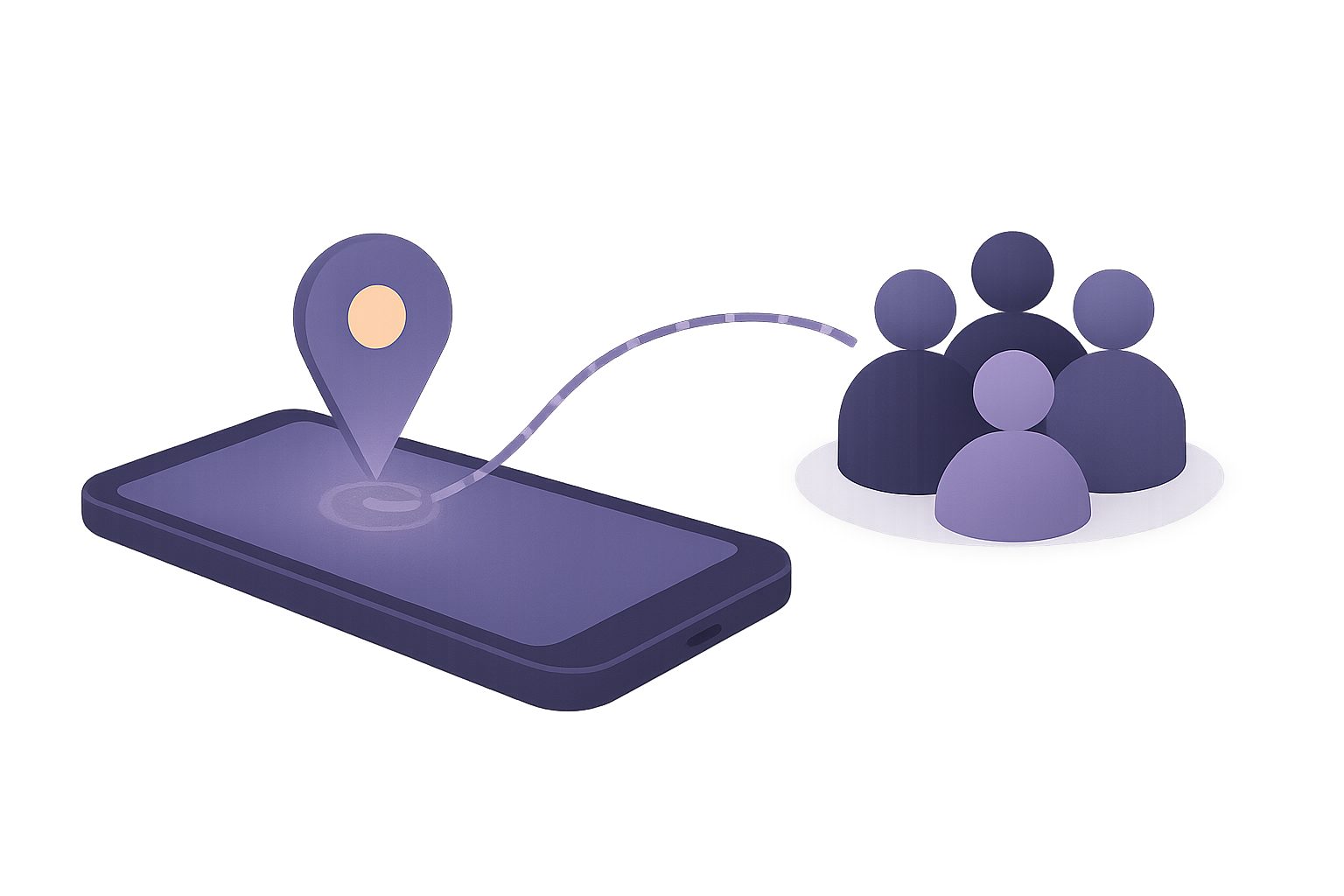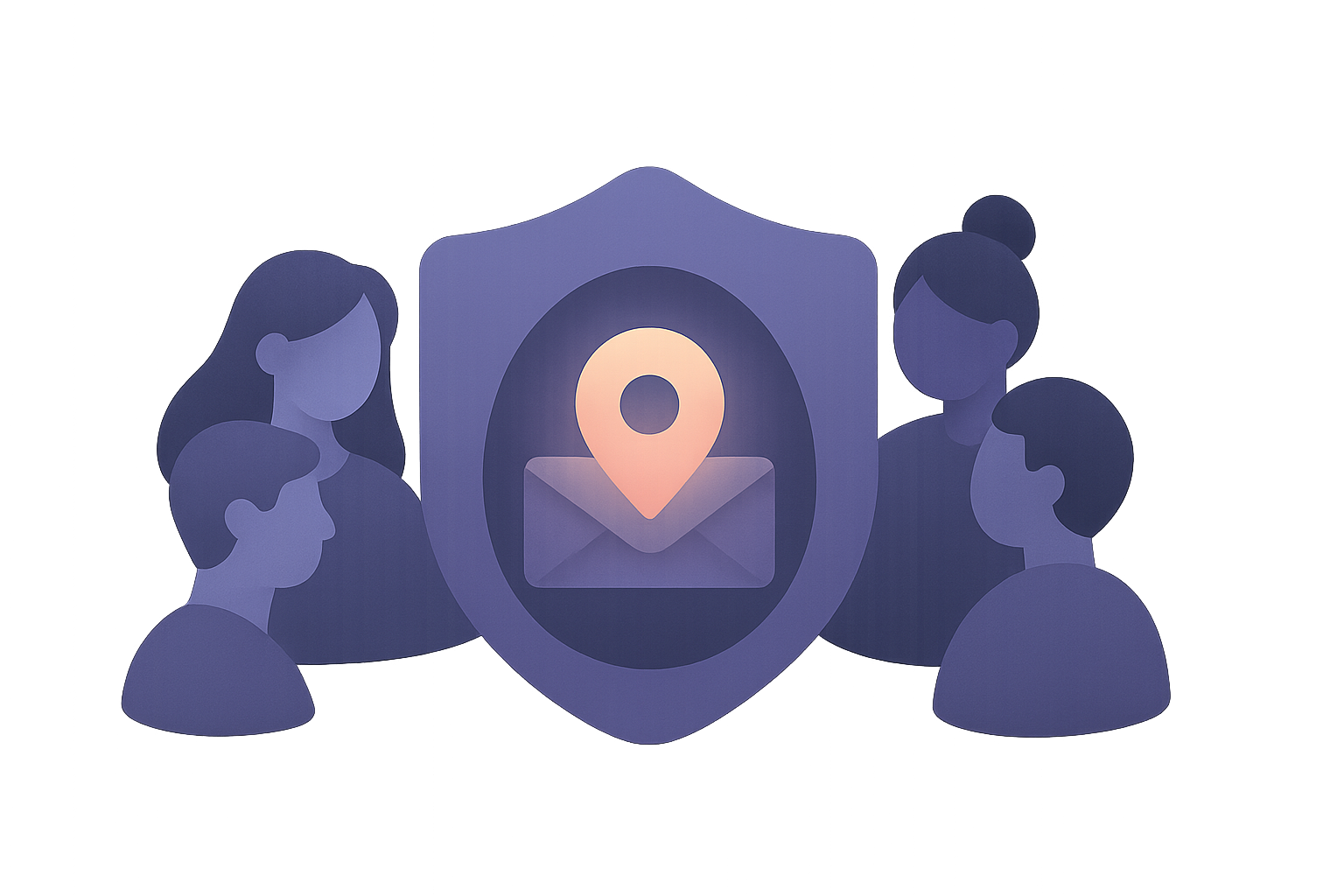
Private location sharing lets you share your real-time whereabouts with specific people you trust — and no one else, not even the company that makes the app. It works by encrypting your location on your own phone before it’s sent, so the servers in the middle only ever pass along a sealed envelope they can’t open. That’s the whole idea, and it’s a meaningful departure from how most location sharing apps actually work.
Because here’s the part nobody puts in the marketing: a typical location sharing app keeps a readable copy of everywhere you’ve been on its servers. Your home, your kid’s school, your commute, your Saturday — logged in a form the company can read, analyze, and in some cases sell. Private location sharing is built so that simply can’t happen. This guide explains exactly how, and how to tell the real thing from “private-ish.”
What is private location sharing?
Private location sharing is real-time location sharing with one extra, non-negotiable property: the data is end-to-end encrypted, so only the people you choose can read it. The app provider can route your location to your circle, but it cannot see where you are.
The word doing the heavy lifting is “cannot.” Plenty of apps promise they won’t misuse your data — that’s a promise about behavior. Private location sharing is a guarantee about capability: the system is designed so that looking isn’t possible, even under pressure. The difference matters enormously, and we’ll come back to why.
How private location sharing works (without the jargon)
Under the hood it comes down to four steps:
- Your keys are generated on your phone. When you set up the app, your device creates a pair of cryptographic keys. The private key never leaves your phone — it isn’t uploaded, backed up to a readable server, or known to the company.
- Your location is sealed before it leaves. Every location update is encrypted on your device using a key only your circle holds — before it ever touches the internet.
- The server only moves sealed envelopes. The company’s servers receive an encrypted blob they can’t decrypt. They can deliver it to the right people; they can’t read what’s inside.
- Only your circle can open it. The people you’ve shared with hold the matching key, so their phones decrypt the update and show your dot on the map. To anyone else — the company, an attacker, a data broker — it’s noise.
The server’s role shrinks from “knows where everyone is, always” to “passes locked boxes between phones.” That one architectural change is what makes everything downstream different.
Private location sharing vs a regular location sharing app
Most location services store a readable history of your movements on their servers. Even with the best intentions, that archive is a standing liability, because it’s exposed to three things no privacy policy can fully control:
- A breach. If your location is readable on a server, anyone who breaks in can read it too. Family-safety apps are a known target precisely because the data is so sensitive.
- A legal demand. Data a company can decrypt is data it can be compelled to hand over. “We’d never share it” doesn’t survive a subpoena.
- A change of heart. Policies get rewritten, free apps add data-sharing to stay afloat, and startups get acquired by companies with different priorities. “Never” quietly becomes “sometimes.”
End-to-end encryption is the only defense that survives all three at once. With a regular app you’re trusting a promise that no one will look. With genuine private location sharing, looking isn’t possible — there’s no readable copy to breach, hand over, or sell.
Is location sharing safe?
Location sharing can be perfectly safe — or quietly risky — and the deciding factor is architecture, not intentions.
It’s safe when it’s end-to-end encrypted, opt-in, and reversible: you choose exactly who sees you and when, and there’s no readable trail left behind. It’s risky when the app keeps a decryptable history it can lose, monetize, or be forced to disclose — no matter how reassuring the privacy page sounds.
A useful test: ask what the worst case actually is. With a private, encrypted app, a breach leaks unreadable data. With a typical one, a breach leaks a map of your family’s life. Same feature, very different blast radius.
You stay in control: opt-in, per-circle, reversible
Privacy isn’t only about encryption — it’s also about consent. Good private location sharing is deliberate, not a firehose that’s always on:
- Opt-in. Off is the default. You turn sharing on when you want it.
- Per-circle. Be visible to your partner without being visible to a wider group; share with close family but not with friends.
- Reversible in one tap. Turn it off and sharing stops immediately — with no lingering trail, because there was never a readable archive to begin with.
This is the line between location sharing and location tracking. Sharing is mutual and consenting; tracking is one-directional and quietly permanent. A well-built app is designed for the first and structurally incapable of the second.
There’s no history to leak
This is the quiet superpower of an encrypted-by-design app: if there’s no readable archive on a server, there’s nothing to breach, nothing to sell, and nothing to be compelled to produce.
The reassurance you actually want — did everyone get home okay? — doesn’t require a company to build a searchable map of your life. It just requires your people’s phones to see each other for as long as you choose. The record of where you’ve been stays nowhere a stranger could ever read it.
The honest trade-off
There’s a real cost to this design, and it’s only fair to name it: if the company can’t read your data, it also can’t recover it for you.
Lose your phone and your recovery phrase, and your history is gone for good — unreadable to everyone, the company included. We think that’s the right trade. A service that could restore your location history on request is, by definition, a service that could be made to reveal it. The recovery phrase puts that power in your hands instead of a company’s. The practical takeaway: store your recovery phrase somewhere safe, the way you would a passport.
How to choose a private location sharing app
Every option will claim to be private. These are the questions that separate the real thing from the rest:
- Is it end-to-end encrypted — and does the company state plainly that it cannot read your location? Vague phrasing like “bank-level security” or “we value your privacy” usually means no. Look for an explicit, unambiguous claim.
- Is sharing opt-in, per-person, and instantly reversible? Always-on-by-default is a red flag.
- Is a readable location history stored on their servers? The best answer is “there’s nothing stored that we can read.”
- How does the app make money? If it’s free with no ads and no subscription, ask what’s being sold. With a truly private app, the honest answer is “nothing — we can’t see your data to sell it.”
- What happens to your data if the company is acquired or shuts down? Encrypted-by-design means the answer doesn’t depend on who owns the servers next year.
If an app can’t answer the first question cleanly, the others don’t matter much.
Who private location sharing is for
The same encrypted foundation fits a lot of everyday needs:
- Families who want the reassurance of “everyone’s home safe” without building a permanent record of their kids’ lives.
- Couples, including long-distance, who want to share whereabouts and plans privately.
- Adult children and aging parents, where a little visibility brings peace of mind on both sides.
- Close friend groups who’d rather coordinate in a private space than on a big social platform.
In each case the appeal is the same: the benefit of staying connected, without the cost of being quietly tracked.
FAQ
Is private location sharing actually safe? Yes, when it’s end-to-end encrypted, opt-in, and reversible. The safety comes from the architecture — sealed on your device, unreadable to the company — not from a promise to behave.
Can the company see my location if it’s end-to-end encrypted? No. Your coordinates are encrypted on your phone with a key only your circle holds. The company’s servers route the data without being able to read it.
What’s the difference between location sharing and location tracking? Sharing is mutual and consensual — you choose who sees you and can stop anytime. Tracking is one-directional and typically keeps a permanent, readable record. Private location sharing is built for the former.
Does private location sharing work across iPhone and Android? It can — encryption is platform-independent. The keys live on each person’s device regardless of whether it’s an iPhone or Android.
What happens if I lose my phone? You restore access from your recovery phrase. Without it, your encrypted history can’t be recovered — by you or anyone else. That’s the deliberate trade-off that keeps it private, so keep your recovery phrase somewhere safe.
Will it drain my battery? Modern location sharing is designed to be light, sending efficient updates rather than constantly pinging. The encryption itself adds a negligible amount of work compared with the location lookup.
Is private location sharing free? It varies by app. The more important question is the business model: if it’s free, make sure “free” doesn’t mean your location data is the product.
Knowing your people are okay shouldn’t require handing a map of your life to a company you’ll never meet. That’s the whole idea behind Sodal: a private space for your circles, where your location — along with your messages, calls, and photos — is sealed so that only the people you choose can ever see it.